June 16, 2026: ChatGPT remains the world’s most downloaded AI app, but a new industry report shows Anthropic’s Claude is doing something OpenAI’s chatbot cannot: turning a larger share of its users into paying subscribers, and earning more money from each one.
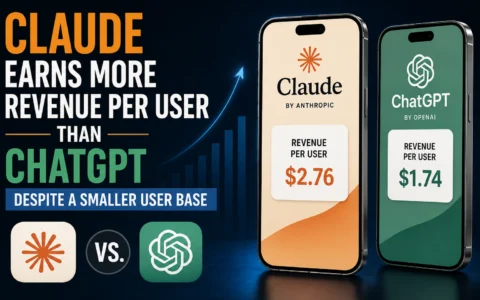
According to Sensor Tower’s State of AI report, Claude generates an average of $2.76 in revenue per user, compared to $1.74 for ChatGPT, making Claude’s monetization roughly 1.5 times stronger on a per-user basis, even though its overall user base is a fraction of ChatGPT’s size.
ChatGPT Still Leads on Scale, But the Gap Is Closing
There is no disputing which app dominates by raw numbers. ChatGPT’s iOS and Android apps crossed 1 billion monthly active users last month, just three years after the app first arrived on smartphone app stores, a milestone that makes it one of the fastest-growing consumer apps in history.
But scale and market dominance are no longer the same thing. ChatGPT’s global market share fell below 50% for the first time, according to the same Sensor Tower report, with the chatbot now holding just over 1.1 billion monthly users, followed by Google’s Gemini at 662 million and Claude at 245 million. ChatGPT remains comfortably ahead in raw user count, but the direction of travel favors its challengers.
Why Claude Converts More Paying Users
The clearest sign of Claude’s strength shows up in subscription numbers. 13% of Claude’s iOS users pay for a subscription, compared to just 8% for ChatGPT. That five-point gap, combined with Claude’s higher per-user revenue, suggests Anthropic has built an app that converts curious users into paying customers more effectively than its larger rival.
User retention tells a similar story of Claude closing the gap. ChatGPT still leads in keeping new users, with an 86% retention rate for people who signed up last month. Claude’s retention rate has climbed to 73.7%, narrowing what was once a much wider gap between the two apps.
Did ChatGPT’s Pentagon Deal Spark a Loss of Users?
ChatGPT has a clear early-mover advantage, but the report notes that users remain willing to try alternative AI assistants. That willingness became evident in March, when OpenAI’s decision to sign a deal with the U.S. Department of Defense, after Anthropic had reportedly restricted similar government access, was followed by a sharp spike in ChatGPT uninstalls, likely in protest. ChatGPT uninstalls peaked at 202% above their usual numbers in the second week of March, the report shows.
Claude’s global market share rose from 5.1% in February to 10% in April over the same period, though the report does not draw a direct causal line between the two events. Sensor Tower’s broader findings suggest that brand trust and values alignment are starting to influence which AI assistant people choose, not just raw features or pricing.
Gemini Is Quietly Gaining Ground Too
While the Claude-versus-ChatGPT comparison has drawn most of the attention, Google’s Gemini is the fastest-growing app in several major markets, including the United States, Canada, most of the European Union, Japan, and South Korea. ChatGPT still remains the biggest AI app by monthly users in most countries globally, with the notable exceptions of Russia and China, but Gemini’s growth in wealthy, high-spending markets makes it a long-term threat worth watching. Much of that momentum is tied to Gemini’s integration across Google’s existing ecosystem of tools like Search, Gmail, and Docs.
Pricing Pressure Is Building Across the Industry
The competition is starting to show up in pricing decisions, not just download charts. The Wall Street Journal has reported that OpenAI was considering major price cuts for its AI tools to better compete with Anthropic, a move aimed primarily at enterprise customers rather than individual app subscribers.
On the consumer side, Google has already cut the price of its cheapest Gemini AI Plus plan from $8 to $5 per month. OpenAI’s cheapest “Go” tier remains priced at $8 per month, while Claude does not currently offer a low-cost or “lite” tier, with its base subscription plans starting at $20 per month.
That pricing gap may explain part of why Claude’s revenue per user is higher. Without a cheap entry-level tier diluting the average, Claude’s paying users are, on average, spending more than ChatGPT’s broader and more price-sensitive user base.
Price Comparison — Claude vs ChatGPT vs Gemini
| App | Cheapest Paid Tier | Free Plan Available | iOS Paid Conversion Rate |
|---|---|---|---|
| ChatGPT | $8/month (“Go” tier) | Yes | 8% |
| Claude | $20/month (no lite tier) | Yes | 13% |
| Gemini | $5/month (AI Plus, cut from $8) | Yes | Not disclosed in report |
What You Get on the Free Plan
All three apps offer a free tier, but the experience differs sharply once usage limits kick in.
- ChatGPT’s free plan: gives users access to a capable model with daily message limits, basic web browsing, and image generation at a reduced rate. It is the most generous entry point of the three for casual users who chat occasionally rather than daily.
- Claude’s free plan: offers access to a strong general-purpose model but with tighter usage caps, especially for longer conversations or document uploads, which makes it better suited to occasional, lighter use rather than daily heavy reliance.
- Gemini’s free plan: is tightly integrated with Google’s existing ecosystem, including Gmail, Docs, and Search, giving free users contextual benefits the other two apps cannot match without a paid plan.
What You Get on the Paid Plans
- ChatGPT’s paid tiers unlock higher message limits, faster response times, advanced reasoning models, and stronger multimodal features like voice and image generation, making it attractive for users who want an all-in-one assistant.
- Claude’s paid tier, starting at $20 per month with no cheaper “lite” option, focuses on longer context windows, stronger coding and writing performance, and fewer usage interruptions, positioning it as a tool aimed more at professionals and power users than casual subscribers.
- Gemini’s paid tier, now starting at $5 per month after the recent price cut, emphasizes deep integration with Google Workspace tools, making it a practical option for users already embedded in Google’s ecosystem who want AI features layered directly into their existing apps.
The pricing gap helps explain the revenue-per-user numbers: Claude’s lack of a cheap entry tier means its paying base, while smaller, is generally spending more per person than ChatGPT’s broader and more price-sensitive audience.
Apple’s Siri AI Could Disrupt All Three
Looking ahead, the report flags one development that could reshape monetization across the entire sector: Apple’s plan to roll out its own Siri AI later this year. Notably, Siri AI is expected to run partly on-device, directly on a user’s iPhone, rather than relying entirely on a paid subscription model the way ChatGPT, Gemini, and Claude currently do.
If Apple’s approach proves popular, it could pressure all three companies to rethink how they price and package their AI assistants, particularly for casual users who may prefer a built-in, lower-cost alternative over a separate subscription.
The Bigger Picture: AI App Spending Is Surging
Despite the competitive turbulence, the overall AI app economy continues to expand rapidly. People are on pace to download nearly 2.3 billion AI apps in the first half of 2026 and spend over $4.2 billion on them, according to Sensor Tower estimates. That figure is already well ahead of the $1.83 billion spent in the first half of 2025, underlining just how quickly the category is growing even as competition between the major players intensifies.
FAQ — Claude vs ChatGPT Revenue
Does Claude make more money than ChatGPT overall?
No. ChatGPT’s total revenue is far higher because of its much larger user base, with over 1.1 billion monthly users compared to Claude’s 245 million. However, Claude earns more revenue per individual user, at $2.76 compared to ChatGPT’s $1.74.
Why does Claude have a higher subscription rate than ChatGPT?
According to the Sensor Tower report, 13% of Claude’s iOS users pay for a subscription, compared to 8% of ChatGPT’s users, suggesting Claude’s user base skews toward more committed, paying customers.
Why did ChatGPT lose market share to Claude in early 2026?
A surge in ChatGPT uninstalls followed OpenAI’s deal with the U.S. Department of Defense in March, with uninstalls peaking 202% above normal. Claude’s market share rose from 5.1% to 10% in the months that followed, though the report stops short of confirming a direct cause and effect.
Which AI app has the most monthly users?
ChatGPT remains the largest AI app worldwide by monthly active users, with over 1.1 billion monthly users, ahead of Gemini’s 662 million and Claude’s 245 million.
Is Claude more expensive than ChatGPT?
Claude does not offer a low-cost entry tier, with plans starting at $20 per month. ChatGPT’s cheapest “Go” tier is priced at $8 per month, while Google’s cheapest Gemini AI Plus plan was recently cut to $5 per month.