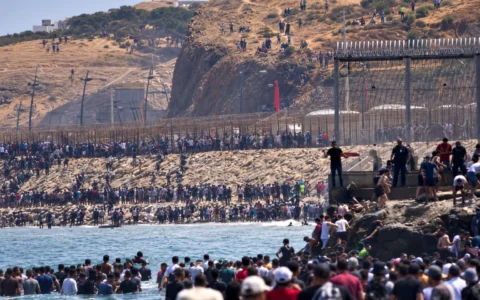
One of the largest single migration events in modern European history has unfolded on a narrow strip of Spanish land in North Africa. Between Thursday and Friday, Spanish and Moroccan authorities estimate that as many as 60,000 people crossed from Morocco into the Spanish enclave of Ceuta, a city of roughly 85,000 residents. In simple terms, the arrivals equalled close to 70 percent of the entire local population in under two days.
The scale is difficult to overstate. When a similar surge hit Ceuta in May 2021, about 8,000 people entered over two days, and it was treated as a record breach at the time. This week’s figure is several times larger, and it happened faster.
According to Reuters and CNN, the death toll had climbed to at least 67 by the weekend. Many of the victims drowned while swimming around the maritime barrier, and others were crushed in the crush at the Tarajal beach breakwater, where crowds pressed against the fence that marks the border.
How the crossings happened
Most people did not scale a fence. They went around it.
Because Ceuta sits directly on the Mediterranean coast, the border extends into the water, and calm summer seas made swimming a realistic option. The Spanish refugee charity CEAR noted that the flat conditions this time of year lowered the risk enough that thousands were willing to try. Many arrived clinging to inflatable rings, with their phones sealed inside waterproof pouches so they could film the moment they reached Spanish sand.
That detail points to something new about this crisis, and it is where the story goes beyond the raw numbers.
The role of social media
Reporting by the Spanish outlet El Español revealed that the crossings were not random. They were coordinated online.
Migrants used TikTok and Instagram accounts to share the exact launch point, the town of Fnideq on the Moroccan side, which sits closest to Ceuta. The accounts advised followers on timing, telling them to set off according to the tide and the fog, since low visibility made it harder for patrols to intercept swimmers. Some of these clips reportedly drew thousands of views before the accounts were deleted and quickly rebuilt under new names.
The purpose, according to the reporting, was a pull effect. Every successful crossing that went viral encouraged more people back in Morocco to attempt the same journey. It turned a border breach into something closer to a live, shared event.
What pushed people to cross
The causes were layered, and no single factor explains the surge on its own.
The first was economic. Many of those who crossed spoke openly about hardship at home. Dounia Kherradi, a young waitress who joined the crossing, told reporters that her wage could not cover the cost of caring for her parents and her daughter, and that she left in search of a better future. Her account was echoed by many others who described low pay and few prospects in Moroccan cities.
The second was a legal rumour. Earlier in July, Spain’s Supreme Court ruled that migrants intercepted at sea could not be summarily returned to Morocco without proper due process. Reports of that ruling spread quickly across migrant chat groups and were widely misread as proof that anyone reaching Ceuta by water would be allowed to stay. Spanish officials say human smuggling networks seized on that confusion to push crowds toward the coast.
The third was diplomatic. Several analysts pointed to renewed friction between Madrid and Rabat. Morocco does not recognise Spanish control over Ceuta and Melilla, viewing both as occupied territory, and relations had cooled again after recent Spanish outreach to Algeria. Some observers questioned whether Moroccan border forces initially eased their watch, as they were accused of doing during the 2021 crisis. Moroccan officials have not confirmed this.
Spain’s response
Prime Minister Pedro Sánchez travelled to Ceuta and described the situation as a violation of Spanish sovereignty. He ordered the armed forces to support the Civil Guard in securing the border, and pledged to return arrivals to their countries of origin as fast as possible.
Sánchez also outlined concrete measures. As an immediate step, the government said it would install maritime buoys in the water to mark a visible sea border. Over the longer term, he said Spain was considering changes to its immigration law to strengthen and speed up repatriation.
The effort to send people back moved quickly. By Friday afternoon, Spanish authorities said that more than 48,000 of those who had crossed had already returned to Morocco, many voluntarily, once it became clear that the small enclave had no capacity to feed or shelter them. Ceuta’s regional president, Juan Jesús Vivas, called the situation an absolute humanitarian and social emergency and warned that reception centres had been overwhelmed for days, with hundreds of people sleeping on the streets.
A political and European flashpoint
Inside Spain, the crisis reopened a fierce debate over migration policy. Opposition figures blamed the government’s generally supportive stance on immigration, pointing to an earlier plan to grant legal status to roughly half a million undocumented residents. Santiago Abascal, leader of the right wing Vox party, posted videos describing the influx as an invasion, and those clips gathered millions of views within hours.
The reaction spread well beyond Spain, because Ceuta is not only Spanish soil. It is one of the European Union’s two land borders with Africa, alongside Melilla. That status meant the surge instantly became a European problem.
Italy temporarily reinstated some border checks on travel arriving from Spain, and France ordered extra controls along its own frontier to prevent onward movement. Several European leaders went further and called for Spain to be temporarily excluded from the open border Schengen zone until the situation was under control.
What comes next
For now, the immediate wave appears to have receded, with most arrivals returned and the border reinforced. But the underlying pressures have not gone away. The economic hardship driving people north remains, the diplomatic tension between Spain and Morocco is unresolved, and the online networks that coordinated this crossing can reassemble at any time.
Ceuta has been a pressure point between Europe and Africa for centuries, held by Spain since the 16th century. This week showed how fast that pressure can turn into a full emergency, and how quickly a local border story can become a continental one.
Times Square News will continue to update this story as official figures are confirmed.