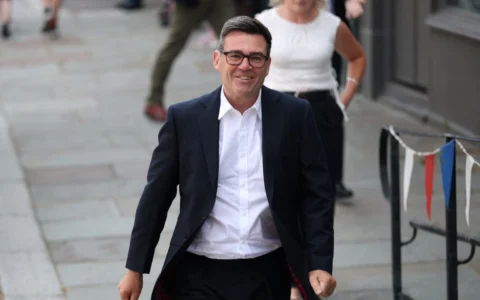
Andy Burnham has officially taken over as the United Kingdom’s new Prime Minister on Monday, July 20, 2026, becoming the country’s seventh head of government in just ten years and pledging to rebuild trust in British politics from the ground up.
Key Takeaways
- Andy Burnham, 56, was formally appointed Prime Minister by King Charles III on July 20, 2026
- He succeeds Keir Starmer, who stepped down in June following election defeats and mounting pressure from within the Labour Party
- Burnham is the UK’s seventh Prime Minister since 2016, a record of political instability unmatched in modern British history
- His first speech outside No. 10 Downing Street focused on cost-of-living, ending rough sleeping, and a 10-year national renewal plan
- Several senior Starmer Cabinet members, including Deputy PM David Lammy and Chancellor Rachel Reeves, have announced their departures
- Donald Trump called Britain a “Poverty Stricken Disaster” hours after Burnham took office
- Burnham spoke with Trump by phone within hours of being sworn in
A Historic Day at Downing Street
Monday, July 20, 2026 marked a defining moment in British political history. Andy Burnham, the former Mayor of Greater Manchester and long-time Labour heavyweight nicknamed “King of the North”, walked through the famous black door of 10 Downing Street as the United Kingdom’s new Prime Minister.
The transition followed Keir Starmer’s resignation as Labour Party leader in June 2026, after a turbulent two years in power marked by opinion poll collapses, U-turns on key policies, and growing discontent within his own parliamentary party.
Burnham was appointed unopposed as Labour leader and was subsequently invited by King Charles III to form a new government, a constitutional formality known as “kissing hands” at Buckingham Palace.
Burnham’s First Speech: “Britain Needs to Believe Again”
Speaking without a lectern or notes, a deliberate departure from the polished political theatre his predecessor was known for, Burnham delivered a speech that was personal, direct, and heavily focused on public trust.
“I am acutely conscious that I am the sixth person in the last ten years to walk up this street, the seventh Prime Minister since 2016,” he told the crowd gathered outside Downing Street. “Making this a moment for reflection and new resolution.”
He did not shy away from acknowledging the scale of public frustration. “I know people at home are fed up with politics. I hear you. And I want to be honest with you, we have not been good enough, and we need to be better.”
Among his headline commitments:
- Ending rough sleeping — announced as his very first act upon entering Number 10
- A 10-year national plan to rebuild Britain’s economy and public services
- New cost-of-living measures to be unveiled on Tuesday, his second day in office
- Building more council homes as a long-term solution to housing and welfare costs
- Maintaining defence commitments to international partners, including Ukraine
- A “more preventative state” — investing in people’s wellbeing rather than managing failure after the fact
“We will make this moment a circuit breaker for Britain,” Burnham said. “Let us make this the moment when Britain starts to believe again. The moment we bring back hope.”
Who Is Andy Burnham?
Burnham, 56, is one of Labour’s most recognisable figures, and one of the few to have maintained genuine popular appeal across different regions of England.
Born in Aintree, Merseyside, he served as a Labour MP from 2001 and held senior Cabinet positions under both Prime Ministers Tony Blair and Gordon Brown, including roles as Health Secretary and Home Secretary.
After losing the 2015 Labour leadership contest to Jeremy Corbyn, Burnham pivoted to local politics and became Mayor of Greater Manchester in 2017, a role he held until returning to Westminster this year.
It was during his mayoral tenure that he built his national profile, most notably during the COVID-19 pandemic when he publicly clashed with Boris Johnson’s government over funding for Greater Manchester during tier restrictions, a moment that cemented his image as a plain-speaking champion of the North.
His political philosophy, dubbed “Manchesterism”, centres on devolution, public ownership of key utilities, long-term economic planning, and rebuilding Britain’s post-industrial communities.
Starmer Bows Out: “The Privilege of My Life”
Earlier on Monday morning, Keir Starmer made his farewell speech outside Downing Street before departing for the final time as Prime Minister.
Starmer said it had been “the privilege of my life” to serve in the role and wished his successor “every success.” He insisted his two years in office had left Britain a “better place,” though that assessment will be contested by many given the political turbulence that ultimately forced him out.
Starmer becomes the shortest-serving Labour Prime Minister in history, a legacy that will define how his time in office is remembered.
Major Cabinet Departures
The transition has triggered a significant reshaping of Britain’s senior government. Several heavyweight figures from the Starmer era confirmed they would not be continuing in Cabinet:
- David Lammy — former Deputy Prime Minister and Justice Minister (previously also Foreign Secretary) said it was the “greatest privilege of my life” to serve, but acknowledged a new Prime Minister was “entitled to build his own team.”
- Rachel Reeves — Chancellor of the Exchequer, the first woman to hold the role in British history, also announced her departure.
Burnham is expected to announce his full Cabinet lineup imminently, with significant attention on who he appoints as Chancellor given his more left-leaning economic platform compared to Reeves.
Trump Calls Britain a “Poverty Stricken Disaster”
The new Prime Minister’s first day was not without international turbulence. US President Donald Trump took to social media to describe Britain as a “Poverty Stricken Disaster”, a sharp and provocative response to the change in UK leadership.
Despite Trump’s public tone, Burnham spoke with him by phone within hours of being sworn in. White House sources confirmed the call took place but did not release specific details. The leaders are believed to have discussed North Sea oil and gas drilling, an area of potential cooperation that Trump signalled interest in, posting that people in Aberdeen would be “dancing in the streets.”
The exchange signals that while the personal chemistry between London and Washington may be frostier than under Starmer, practical diplomacy remains on the table.
Markets React with Caution
Financial markets have been watching Burnham’s rise carefully. His platform, which includes renationalisation of key services and greater state intervention in housing and utilities, sits to the left of the Starmer-Reeves economic framework that investors had largely grown comfortable with.
Bond market analysts noted earlier this year that the prospect of a Burnham premiership introduced fresh uncertainty for UK gilts. However, Burnham has argued that his model, focused on reducing long-term state costs through housing investment and prevention rather than crisis management, is ultimately the fiscally responsible path.
Full market reaction to his cabinet appointments and Tuesday’s cost-of-living announcement will be closely watched.
What This Means for the UK
Andy Burnham inherits a Britain facing a familiar set of challenges: sluggish economic growth, a cost-of-living squeeze that has hit working families hard, a housing crisis, and a public increasingly disengaged from mainstream politics.
His pitch is that he represents not just a change in personnel, but a genuine change in approach, shifting from the technocratic centrism of the Starmer years toward something more directly connected to communities and working people.
Whether he can deliver on that promise will define his premiership. But on Day One, the message was clear: the “King of the North” has arrived in Downing Street, and he intends to govern differently.
Frequently Asked Questions
Why did Keir Starmer resign?
Starmer stepped down as Labour leader in June 2026 following a series of election defeats, sustained drops in opinion polls, and significant discontent within the Labour parliamentary party. He had faced criticism over policy U-turns and his handling of several domestic and international issues.
How did Andy Burnham become Prime Minister without a general election?
In the UK’s parliamentary system, the Prime Minister does not need to face a general election when a party changes its leader mid-term. Burnham was elected as Labour Party leader and, as leader of the governing party, was invited by the King to form a government. A general election is not required until 2029.
What is “Manchesterism”?
Manchesterism is the term used to describe Burnham’s economic philosophy, centred on devolution of power to regions, public ownership of essential utilities, long-term infrastructure investment, and collaborative planning between government and communities, drawing on the model he developed as Mayor of Greater Manchester.
Who is Andy Burnham’s wife?
Andy Burnham’s wife is Marie-France van Heel. The couple were seen entering Downing Street together on Monday.
What will Burnham announce on Tuesday?
Burnham has confirmed he will unveil new cost-of-living measures on Tuesday, July 21, 2026 — his first full day in office. Further details of his 10-year national plan are expected later in 2026.
Conclusion
Andy Burnham’s arrival at Downing Street closes one turbulent chapter in British politics and opens another. As the UK’s seventh Prime Minister in a decade, he carries not just a policy agenda but a burden of proof, demonstrating that Labour, and Britain itself, can find stability after years of upheaval.
His first speech was a deliberate break from the scripted and polished norms of his predecessors. Whether that authenticity translates into effective governance remains to be seen. But for now, a new era has begun.
Stay up to date with the latest UK political news, breaking stories, and global updates at Times Square News. Explore more in our News and Business sections.