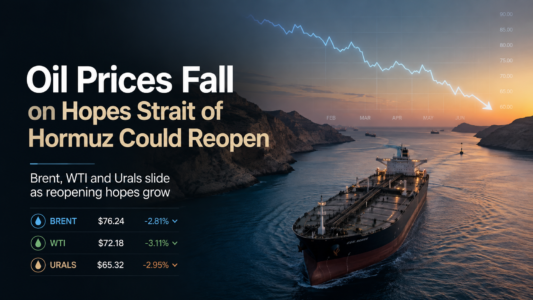
Oil prices dropped again this week, and the reason sits in one narrow stretch of water off Iran’s coast. Traders are betting that the Strait of Hormuz — shut for most of the year — may finally reopen. That single hope has done more to move the crude oil Urals price and global benchmarks than any supply report in months.
Quick answer: Oil prices are falling because senior US officials signaled progress on a US–Iran deal to reopen the Strait of Hormuz. On August 4, 2026, Brent crude slid nearly 5% to below $80 a barrel and WTI dropped past 5% to around $76, hitting a three-week low as traders priced in the return of blocked supply.
Prices remain volatile, though. Similar hopes have collapsed before, so the numbers below reflect early August 2026 and can shift within a single trading session.
Table of Contents
- Why Oil Prices Are Falling Right Now
- Why the Strait of Hormuz Matters So Much
- What Are Current Crude Oil Prices?
- Crude Oil Urals Price: Where Russian Crude Fits In
- Brent Crude Oil Price History and the “War Premium”
- Brent Crude Oil Future Price: What Could Happen Next
- What Falling Oil Prices Mean for You
- Frequently Asked Questions
- Key Takeaways
Why Oil Prices Are Falling Right Now
The move down started with two names: US Secretary of State Marco Rubio and Treasury Secretary Scott Bessent. Both said talks with Iran had advanced far enough that oil shipments through the Strait of Hormuz could resume within days. Mediators from Qatar and Oman echoed the message.
Markets reacted fast. Brent, the benchmark for roughly two-thirds of the world’s oil, fell to a three-week low, and US West Texas Intermediate (WTI) followed. Wall Street rose in tandem, since cheaper energy eases inflation fears.
Here’s the catch: the strait is still effectively closed. Reports of a finished draft agreement between Iran and Oman lifted sentiment, but no barrels are flowing yet on the deal. That gap between hope and reality is exactly why every headline swings the price so sharply.
Traders have learned to stay skeptical. A ceasefire agreed in June unraveled in July, followed by nearly two weeks of tit-for-tat strikes. So while the drop is real, few analysts are calling it the end of the crisis.
Why the Strait of Hormuz Matters So Much
If you only remember one fact from this article, make it this: the Strait of Hormuz is the single most important oil chokepoint on Earth.
Before the conflict began in late February 2026, the waterway carried about one-fifth of the world’s daily oil and liquefied natural gas (LNG) supply. Crude from Saudi Arabia, the UAE, Kuwait, Iraq, and Iran must pass through it to reach global buyers. There is no full-capacity alternative route.
When shipping through the strait stalls, the effect ripples outward in a predictable chain:
- Tankers turn back or reroute, cutting available supply.
- Insurance and freight costs spike for any ship still willing to sail.
- Buyers scramble for barrels elsewhere, bidding prices up.
- Pump prices climb weeks later for ordinary drivers.
That’s why a diplomatic signal — not an actual barrel of oil — can move the entire market in minutes. The strait isn’t just a supply route. It’s the hinge the global energy market swings on.
What Are Current Crude Oil Prices?
Prices below reflect early August 2026 and move throughout the trading day. Treat them as a snapshot, not a fixed rate.
| Benchmark | Region / Role | Approx. Price (Aug 2026) | Notes |
|---|---|---|---|
| Brent Crude | North Sea / global benchmark | ~$80–83 / bbl | Prices two-thirds of world oil |
| WTI Crude | US / North America | ~$76–78 / bbl | Key US benchmark |
| Dubai Crude | Middle East / Asia | ~$76–77 / bbl | Asian pricing reference |
| Urals Crude | Russia’s main export blend | See section below | Wide provider variance |
The pattern to watch is the direction, not the exact decimal. All major benchmarks have trended down from war-driven peaks near $120 a barrel earlier in the year as ceasefire and reopening talk gathered pace.
Why the numbers differ across websites: Each benchmark reflects a different crude grade, delivery point, and settlement time. A live quote you see at 9 a.m. may already be stale by lunch. For decisions that carry money, always check the settlement price on a recognized exchange or data provider.
Crude Oil Urals Price: Where Russian Crude Fits In
The crude oil Urals price tells a separate but connected story. Urals is Russia’s flagship export blend — a medium, sour grade shipped from Baltic ports like Primorsk and Ust-Luga and the Black Sea terminal at Novorossiysk. It usually trades at a discount to Brent because of its higher sulfur content and, since 2022, Western sanctions.
Two things stand out in the Urals market right now:
1. The prices vary a lot by source. Urals averaged about $65.48 a barrel in July 2026, ranging from roughly $51 to $87 across the month, depending on the data feed. Live quotes in early August span a wide band, so cross-check before quoting a single figure.
2. The discount to Brent has narrowed sharply. The Urals–Brent gap, once as wide as $20–35 a barrel after sanctions, has compressed to just a few dollars. The drivers: strong demand from India and China, a shortage of available tanker capacity, and disruptions to Russian refining and Black Sea shipping.
So while the Hormuz story dominates headlines, Urals sits inside its own tug-of-war — one shaped by sanctions, the G7 price cap, and Asian buyers rather than by Iran. When you follow hormuz strait news, remember that Russian crude marches partly to a different drum.
Brent Crude Oil Price History and the “War Premium”
To read today’s price, you need the recent path behind it. Brent crude oil price history over 2026 reads like a heartbeat monitor.
- Late February 2026: War breaks out; the strait effectively closes.
- April 2026: Brent spikes above $126 a barrel at the peak of the panic.
- Early summer: A June ceasefire pulls prices back toward pre-war levels near $72.
- July 2026: The ceasefire collapses; strikes resume and prices whipsaw again.
- Early August 2026: Reopening hopes push Brent back toward $80.
That extra amount buyers pay purely for the risk of supply loss is called the war premium. When a deal looks close, the premium deflates and prices fall — even if nothing physical has changed yet. When talks break down, it inflates again overnight. Understanding that mechanism explains almost every sharp swing you’ll see reported.
Brent Crude Oil Future Price: What Could Happen Next
No one can promise a Brent crude oil future price, and anyone who does is guessing. What analysts can map is the range of realistic paths:
Scenario 1 — The deal holds. If Iran and Oman sign and the strait reopens, blocked supply floods back. Prices could ease meaningfully as the war premium disappears. This is the outcome markets are currently betting on.
Scenario 2 — The deal stalls or collapses. Given the June ceasefire’s failure, a breakdown wouldn’t shock anyone. Prices could snap back toward or above $100 a barrel within days.
Scenario 3 — A slow, partial reopening. Ships resume in limited numbers while talks continue. This muddy middle keeps prices choppy — the pattern of much of 2026.
The honest takeaway: expect volatility, not a clean trend. The market is trading on diplomacy, and diplomacy rarely moves in a straight line.
This section is for general information only and is not financial or investment advice.
What Falling Oil Prices Mean for You
You don’t have to trade oil to feel this story.
- Drivers: Pump prices lag the market by weeks. Earlier in the crisis, UK petrol reached around £1.60 a litre and US gasoline topped $4 a gallon. A sustained drop in crude eventually shows up at the forecourt.
- Businesses: Freight, aviation, plastics, and agriculture all track fuel costs. Lower crude gives budgets room to breathe.
- Investors and savers: Energy prices feed inflation, which shapes interest-rate decisions. Cheaper oil can ease pressure on central banks.
- Everyday households: Heating, shipping, and food costs all carry an energy component. The strait’s status touches your grocery bill indirectly.
That’s the real reason this niche waterway leads business news worldwide. Its ripple reaches your wallet.
Frequently Asked Questions
1. Why are oil prices falling this week? Because US officials signaled progress on a deal to reopen the Strait of Hormuz. Traders expect blocked supply to return, so they’ve priced crude lower — Brent slid below $80 and WTI toward $76 in early August 2026.
2. What is the current crude oil Urals price? Urals averaged about $65.48 a barrel in July 2026, with monthly quotes ranging from roughly $51 to $87 depending on the data source. Always confirm on a recognized provider before acting on a single figure.
3. Is the Strait of Hormuz open right now? As of early August 2026, it remains effectively closed. Talks point toward reopening, but no full-capacity deal has been implemented yet.
4. How much of the world’s oil passes through the Strait of Hormuz? About one-fifth of global daily oil and LNG supply moved through it before the 2026 conflict.
5. What’s the difference between Brent, WTI, and Urals? Brent is the global benchmark from the North Sea. WTI is the main US benchmark. Urals is Russia’s export blend, usually cheaper due to quality and sanctions.
6. Why is the Urals–Brent discount shrinking? Strong demand from India and China, limited tanker capacity, and disruptions to Russian refining and Black Sea shipping have narrowed the gap to just a few dollars.
7. What was the highest oil price in 2026? Brent spiked above $126 a barrel around April 2026, at the height of the supply panic.
8. Will oil prices keep falling? It depends entirely on the deal. If it holds, prices could ease further; if talks collapse, they could rebound sharply. Expect volatility rather than a smooth trend.
9. How do Hormuz tensions affect petrol prices? Higher crude raises refinery and shipping costs, which reach pumps within weeks. Falling crude works the same way in reverse, with a lag.
10. What is the “war premium” in oil prices? It’s the extra amount buyers pay to insure against supply loss during conflict. It inflates when talks fail and deflates when a deal looks likely.
11. Who are the biggest buyers of Russian Urals crude now? India and China have become the primary buyers since 2022 sanctions redirected Russian barrels away from Europe.
12. Where can I track live oil prices reliably? Use recognized exchanges and data providers, and check settlement prices rather than intraday quotes for decisions involving money.
Sources & References
For verified data and further reading on oil markets and the Strait of Hormuz, these official sources are worth following:
- U.S. Energy Information Administration (EIA) — chokepoint analysis, benchmark prices, and supply data: https://www.eia.gov
- International Energy Agency (IEA) — global oil supply, demand, and market reports: https://www.iea.org
- OPEC — official production figures and monthly market outlooks: https://www.opec.org