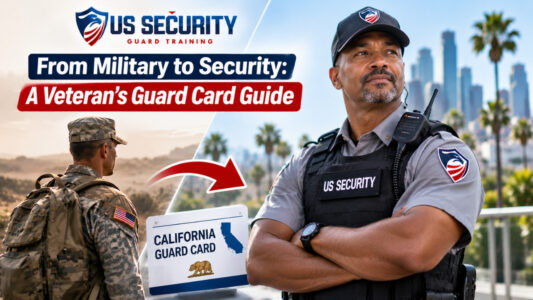
There are a lot of veterans who would like to be hired to work in civilian positions that require discipline, judgment, and leadership. Nevertheless, California has a state guard card that is required prior to anyone performing a security post. This guard card manual is divided into easy to follow steps in a straightforward manner to the veterans. Consequently, you will be able to save time on waiting and get to work earlier when separated. Each section addresses actual charges, timeframes, paperwork, and advantages that exist nowadays.
First, we discuss what the guard card is and why it is required. The guide includes information on eligibility and training, Live Scan, applications, renewals, and armed permits. Moreover, you will also know what veteran benefits can be expedited. We have experience in training new guards and veterans in our school in Chatsworth. Each of the steps represents the actual questions that the students pose during the first week of classes.
Why Veterans Need a California Guard Card
In addition, when you learn how to get a guard card in California, you start your career. The state law is that any private security guard must be registered on BSIS. It cannot be substituted by military service, police experience or concealed carry permit. Consequently, the process is dealt with in this guard card guide as a checklist mission. Do everything sequentially, and you will prevent most frequent delays. A complex state process becomes a straightforward and easy to manage checklist with clear planning.
Basic Eligibility Requirements
California still makes it easy to maintain guard cards eligibility, but each and every rule counts.
To apply to a state registration, applicants should be aged 18 years and above.
To use force and make arrests, you need to complete the eight-hour Power to Arrest and Use of Force course.
You also need to complete a Live Scan background check by the DOJ and FBI.
You have to provide a BSIS application and fee and certificate information.
Even with a previous conviction, it may not necessarily disqualify you to receive a guard card. Rather, BSIS considers each case on a case-by-case basis and takes into account any signs of rehabilitation.
The Guard Card Process Step by Step
It typically has five stages of first class to working status. All in all, this guard card guide maintains every step concise and simple to follow.
Step 1: Complete Power to Arrest and Appropriate Use of Force
The first one is a Power to Arrest and Use of Force course that takes eight hours. In particular, it addresses three hours of arrest authority and five hours of force. Such issues as de-escalation and active shooter response need to be taught in person. You have to get the course exam with a 100 percent score. Also, have a note of the certificate serial number printed on the bottom left.
Step 2: Get Fingerprinted Through Live Scan
Then go to a Live Scan site to have your background check done by submitting fingerprints. Prices are approximately $49, and there is a service fee charged per location. Thus, it is better to make calls in advance and check the hours, the ways of payment, and the appropriate BSIS form. Carry an acceptable photo identification and a filled out BSIS Live Scan request form.
Step 3: Submit Your BSIS Application
You may use an online application using the BSIS Breeze or mail. Breeze is however, not mobile friendly and therefore best used on a desktop. Mailed applications can take a minimum of eight to ten weeks to process. New BSIS forms have a fee of 60 upfront, thus checking the existing fee.
Step 4: Track Approval and Respond to Problems
The BSIS License Search is the DCA License Search, where you can check your status at any time. In the meantime, BSIS sends an apology letter as to the reasons why it is refusing an application. The applicant should appeal within 30 days of receiving such a letter.
Step 5: Finish 32 Hours of Skills Training
Registered guards must complete 32 more hours of security officer skills training. Moreover, 16 of them have to be completed within the initial 30 days. The other 16 hours should be filled up within the official six-month mark. There are four required courses incorporating public relations, observation and documentation, communication and legal liability. In addition, such popular electives as officer safety, trespass, crowd control, and evacuation procedures are offered. The table below presents a glance of the entire first year training timeline.
A Typical Timeline From Separation to First Shift
Imagine a Marine veteran who parted ways in March and desires employment come May. In the first week, he attends the eight-hour Power to Arrest and force course. The following day, he goes to a Live Scan place close to his apartment. That evening he presented his Breeze application on a desktop computer. Then, BSIS accepts his registration, and he takes a local security post. He completes 16 hours of skills in 30 days and the remainder in the summer. The timelines can be varied, but in the case of organized veterans, they can be employed in a few months.
Documents Veterans Should Gather First
Above all, mastering how to get a guard card in California needs paperwork.
- An authentic government photo ID of Live Scan and your state application.
- Your Certificates of completion of Power to Arrest and Use of Force with serial numbers.
- Your DD214 also in case you are requesting expedited veteran licensing assistance.
- The Live Scan form with your name and address completed and the receipt of the place where you have been fingerprinted.
- Lastly, a credit card, check or money order of the BSIS fee.
Keeping Your Guard Card Active
Your guard card will then be valid two years after the issue date. Each guard has to undergo eight hours of continual training every year. The current BSIS fee tables show that renewal costs 44 on time. Expiration is followed by a 60-day grace period with a greater delinquent fee. Following these 60 days, you have to re-apply as a new guard card candidate.
Upgrading to Armed Security Work
Besides, a BSIS firearms permit is added by many veterans to be eligible to serve in armed posts. Applicants have to be 21 years of age and pass a judgment and self control test. The permit will be restricted to the specific calibers that are shown on your permit card. In addition, concealed carry also does not make a guard allow him to work with a gun. Military weapons handling experience is often highly valued and paid more at armed posts.
How Civilian Rules Differ From Military Rules
Certain military customs must be modified when you go on the civilian California law. As an illustration, the guards have powers of citizen arrest and not military police power. The legal limits and close scrutiny of searches, detentions and decisions of the use of force are stringent. The clients would want to receive good customer services and work hard with professional security on all the posts.
New Training Rules Coming in 2029
In the meantime, SB 1203 in California will alter the training of guard cards since January 1, 2029. The skills training will be expanded to 42 hours, eight of them in-person de-escalation. There will be an increase of four in-person hours of annual training to eight to 12 hours of training. Thus, by obtaining your guard card today, you can begin to play under the existing regulations.
Finding Work After Your Guard Card
Your registration can then be approved by BSIS and you can be hired by a licensed security guard company. Moreover, numerous employers compensate for continued training and provide overtime. Find companies that have veteran recruitment and have well-defined advancement into supervisor positions. Companies that provide security guards are appreciating discipline, reliability, and serene leadership qualities. This results in a large number of veterans ascending to supervisor positions more quickly than other new officers. As time goes on, a large number of veterans become team leaders, trainers or handle client accounts.
How US Training Guard Helps Veterans
The training of new guards is done by US Training Guard, in Chatsworth Devonshire Street. Further, we also train the necessary Power to Arrest and Use of Force courses. We are taught about Live Scan, Breeze applications and certificate serial numbers by our instructors in a very straightforward manner. We use this guard card guide with all the veterans who attend our classes. Moreover, we assist students on steps of appeal in case of rejection of an application by BSIS. BSIS license number TIB 1959 is provided in our school to be transparent and trusted. Graduates have opportunities of getting positions in any security guard firm licensed in California. On the whole, we admire your service and support you in the life of a civilian.
FAQs
What is the time to get a guard card in California?
Applications by mail take 8 to 10 weeks and those by the internet tend to take a shorter time. Thus, the BSIS Breeze system is operated on the desktop computer by most applicants.
Am I allowed to work until I get my guard card?
To work any security post in California, you must be approved by the official BSIS. But you can check your acceptance in the DCA License Search.
Do military training list as one of the 40 hours?
No, California needs the state-approved courses to all new guard applicants. Nevertheless, military experience assists you in learning faster and progressing more rapidly afterwards.
Will a prior conviction prevent me from receiving a guard card?
Not in an automatic way, as BSIS checks each of the cases and will take into account evidence of rehabilitation. As such, provide all the application questions with honest and full answers and attach supporting documents.
Should I have a separate permit to have a baton?
Yes, the BSIS batons require separate training and permit of guards who wield batons. In addition, a baton can only be used when in uniform.
What is the price of a California guard card?
Training costs, approximately $49 with Live Scan, and the state application fee. Check current BSIS fees also since they vary with updates to new forms.
Are veterans expedited?
Yes, BSIS shall have to speed up initial licensing of honorably discharged veterans with evidence. Send your DD214 and follow the procedure on the BSIS military applicants page.
Conclusion
In conclusion, this guard card guide turns a confusing process into simple steps. Training, Live Scan, apply online and follow all the deadlines. In addition, veteran benefits have the power to accelerate the process and save a few expenses in between. And your service qualified you well in this next important mission of civilian security.
Begin Your Guard Card Training.
Our group demonstrates the veterans on how they are able to acquire a guard card in California. Graduates have a chance to work with reputable employers that provide security guard services in California. And, at last, come to our Chatsworth establishment, and make your first visit to civilian security.