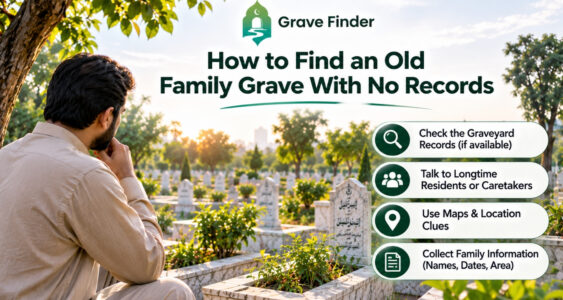
There are a lot of Pakistani families, which have one grave as children saw it, but are unable to find it. The elders that had the way have died, and there is no paper account. Nevertheless, there is seldom no hope in the search provided that you pursue a meticulous, time-sensitive approach. This guide shows the process how to find old grave pakistan in a cautious manner. You will know where to find the hidden clues and the first person to inquire with. You will learn what to do in case of faded headstones and how to cope with unsuccessful searches. Through planning, most families end up discovering the grave that was lost.
Why Old Graves Are So Hard to Locate
Old graves are forgotten by the family because of many reasons and most of them are explained. Plain graves of many Muslims had no permanent headstone and were made up of mounds of mud. These mounds are eventually flattened by rain and time to look like ground. In large cities, there is a burial where there was none and a transformation of the previous plan. In addition, a lot of graveyards did not maintain any proper registers until the advent of computerised registers. Families were transferred across cities, provinces, and countries, with fewer memories every time. Accordingly, the information about a single grave is often held by a single aged family member. When that individual dies, there is little that the family can make use of.
Step 1: Collect Everything Your Family Already Knows
In order to locate a grave in Pakistan that is old, begin with your family knowledge. Record the complete name of the deceased, and the name of his father. Also record the approximate date of death, though as an approximation. Name all the graveyard names that relatives can recall, even the uncertain ones. Then ask who went to the funeral, they usually know the road. Minor details, such as a local mosque, shrine, water tank, or a tree are appreciated. Note also on which side of the graveyard the family used to enter. Have all these notes in a single notebook or an online document shared. In brief, each minute memory turns to a clue as soon as you write it down.
Questions to Ask Elders Before It Is Too Late
The memories that are stored in the minds of the elders are the ones that cannot be ever replaced by a register or record. These are some of the questions that you can ask the next time you have a big family.
- In which cemetery did we bury, and who did we originally bury our family in?
- What was the gate which the funeral entered, and how far did it walk?
- What was close to the grave, e.g. a tree, wall, shrine?
- Do you remember other relatives who were buried there, and do you know all their names?
- Was there a headstone and what was the language or colour of the inscription?
- Who made frequent visits, and could they have any photos or receipts?
Note them down in voice notes, which are able to pick up all the minute details.
Step 2: Search Old Family Papers and Photos
Yes, aged documents can be the best sources of leads to the position of a grave. Burial slips, graveyard receipts, and old death certificates can be found in family cupboards. As an illustration, a burial slip can indicate the plot, row or serial number. Handwritten letters and diaries sometimes mention the graveyard by its full name. In the same way, one can see the photos of funerals and visits including the headstones, walls, and adjacent graves. Check old Quran khwani cards and newspaper condolence notices dates and places. A forgotten picture of the grave can be found in even a forgotten phone. So ask all their branches of the family to look at their houses.
Step 3: Check Official Death Records
The date of death and in some cases the burial spot can be verified by official records. Additionally, deaths in their regions are registered by union councils, TMAs and cantonment boards. These offices have the CRMS system of NADRA that stores computerised death records today.
But there may be deaths in previous decades that are only found in old paper registers. Go to the office which had been paid at the time of death. Bring your notes, the name, the father and approximate year. Registers can be searched manually by staff, and patience and courtesy can be of benefit. In case you come across an entry, either take a copy or photograph it.
Step 4: Visit the Graveyard Office and Caretaker
Next there is the graveyard, which, whether you believe it or not, kept records. Its employees have the ability to locate an old grave in Pakistan within a short time. Most Pakistani graveyards contain an office, a committee, or some caretaker. For example, Lahore’s Miani Sahib has been run by a committee since 1962. There are also more than 10000 records of burials in Mominpura Graveyard in Lahore.
Wadi-e-Hussain provides a number and search online in Karachi. Nevertheless, the gorkan is able to recall older sections of the family even without the use of registers. Many Pakistani families tend to have their jobs as gravediggers being inherited by their sons. The grave will be located in a few minutes, with the assistance of a retired gorkan. Thus, be polite, tell them the purpose of your search, and thank them.
Step 5: Ask the Local Community
Once records run out, local people become your best source of information. Go to a local mosque and meet with the imam or committee of that mosque. In tight-knit mohallas and villages, the elderly neighbours might recall the funeral. Graveyard caretakers and shrines close to the graveyard are usually acquainted with old families and their graves.
Family burial in rural areas was usually done in the ancestral land or village cemetery. So, call faraway family members, still in the ancestral village. Inquire whether your family utilized a given area such as an enclosure of walls. These discussions are time consuming but they mostly give you that piece that is missing.
Searching in Village and Rural Graveyards
They come with their own difficulties, however, as not many village graveyards have any written materials. Burials there are frequently unmarked and the demarcations can be based on the old family land lines. Go there in the daytime with a relative, who is familiar with the village and its families. The burial corner of each family can frequently be named by the village numberdar or elders. Rural areas have old trees, wells, and boundary walls that tend to change gradually. Thus, childhood memories of landmarks in the countryside are frequently quite helpful even nowadays. Observe local practices, and seek permission to enter any personal family plot.
Step 6: Old Photos and Satellite Imagery.
Contemporary instruments can guide you to make a comparison between the graveyard today and the way it used to be. In particular, Google Earth provides an image of history with older satellite images. Open Google earth, type in the name of the graveyard and select the satellite basemap. Next, open up the historical imagery tool and navigate the years available. The images are old and this can show us the way, walls and trees which are no more. These landmarks are next compared with old family pictures taken on previous visits. This will guide you to locate the grave in a single tiny search vicinity. Coverage is however varied and as such clear images may not be available on some years or locations.
Step 7: Go through the Graveyard in Sections.
Having a probable area in mind, search it gradually and very systematically. Split the section in small blocks then walk the rows on one end. Burials that are old tend to be located in the oldest section and hence begin your search there. Seek out family groupings, since family members are frequently interred together.
Check headstones of the name of the father, as many names are repeated many times. Take pictures of all the potential matches including the surrounding graves and landmarks. Take an assistant, two heads are always better than one. By this process you are sure to locate the grave without having to walk hours.
How to Read a Faded Headstone Safely
Here there are frequently carved or painted old headstones, in Urdu, Arabic or Persian. With time such inscriptions become extremely difficult to read because of sun and rain. Never use chalk however, or paint or shaving cream to make letters stand out. The US National Park Service cautions that shaving cream may leave stains on stone. Rather, spray the stone lightly with a small bottle of clean water lightly.
Water modifies surface reflection of light, which can be used to see carved letters. Light that is angled, known as raking light, also causes shallow carvings to be visible. Put a car sunshade or reflector over the stone to reflect the sunlight. Take pictures of the headstone in various positions, and then later on your phone zoom in. In case the script is ancient, request a person who reads Persian or Uruk calligraphy.
FAQs
Is it possible to locate an old grave in Pakistan with no documents?
Yes, numerous families can be successful with a mix of family memories, caretakers and community assistance. Begin with the elders and caretakers and thoroughly search the most probable section.
Is there any record of old deaths in union councils?
Old paper registers are still maintained by many of the union councils in addition to the current computerised NADRA records. But extremely ancient entries can be unfinished, worn or hard to locate.
Is one permitted to excavate in order to ascertain the existence of a grave?
No, you must never turn up or interfere with any grave in your search. Rather, discuss with the graveyard management and a local scholar your concerns.
What about reading a headstone in old Persian or Urdu?
Lightly sprayed with water, and with angled light to show up the letters. Then have it photographed, and have an old calligraphist, who knows the stuff, read it.
What should I do if the grave was reused?
Talk to the graveyard management in a relaxed manner and request any remaining records. Your family can be advised by a trusted scholar on the prayers and further actions.
Conclusion
The process of seeking a lost grave is an exercise of love, patience and memory. You can locate an old grave in Pakistan with the help of memories and the community. Begin at home, pay visits to offices and caretakers, and search on-site. When you are successful, leave the place to the next generation of your family.