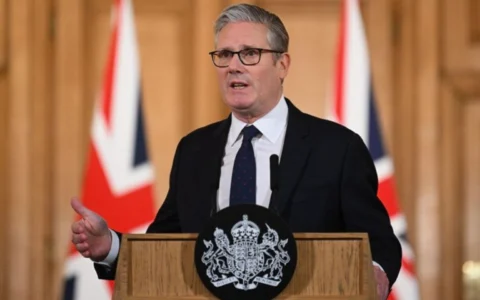
LONDON, June 15, 2026. Britain will ban under-16s from using a range of major social media apps, Prime Minister Keir Starmer announced on Monday, describing it as “a big moment for our country.” The ban is expected to cover platforms including TikTok, Instagram, Facebook, X, YouTube, Snapchat, Threads, Twitch, Kick, and Reddit, and will go further than Australia’s similar law that took effect in December.
What Starmer Announced
Speaking ahead of the formal announcement, Starmer said he is “not prepared to compromise on the safety and happiness of our children,” and warned that he would fight back if technology companies resist the move.
The Prime Minister framed the policy as a direct response to growing concern over children’s mental health and online safety. “How we keep kids safe online is one of the biggest debates of our time,” Starmer said in a statement released ahead of the announcement.
Starmer indicated the UK’s approach would be more prohibitive than Australia’s existing under-16 social media ban, calling Britain’s version a “world-leading” action.
Why This Matters
This announcement marks one of the most significant child online safety interventions by any Western government to date. It positions the UK alongside a growing group of nations, including Australia, Canada, Brazil, and Indonesia, that have introduced legislation or age-based restrictions for children’s social media access, while France, Spain, Denmark, Thailand, and South Korea are reported to be studying or developing similar approaches of their own.
For UK parents and teenagers, the policy could mean significant changes to how, when, and whether under-16s can access some of the most widely used apps in the world.
What Else Is Being Restricted
The ban is not limited to social media platforms alone. According to the Sunday Times, the UK government’s plans would also include restrictions on AI chatbots that could expose children to harmful or inappropriate content, new limits on certain gaming app features designed to encourage prolonged engagement, and a curfew aimed at preventing older teens from late-night scrolling.
The Public Consultation Behind the Decision
The announcement follows a lengthy public consultation process. The UK government received 116,000 responses from parents, the technology industry, and children themselves, a turnout second only to a 2012 consultation on marriage equality in terms of public engagement.
According to Culture Secretary Lisa Nandy, the vast majority of respondents, including young people themselves, wanted an under-16 ban. Speaking to the BBC, Nandy said a ban on its own is not a “silver bullet solution,” but that Australia has shown clearly it has a significant role to play.
Not Everyone Agrees
The plan has already drawn pushback from two very different directions.
The US Embassy in London has said that regulations affecting American technology companies should remain narrow and should not violate free speech protections, adding that it is concerned the rules would place greater burdens on US tech firms.
From an academic standpoint, Jon Crowcroft, a communications systems professor at the University of Cambridge, said that while people supporting social media bans are well-meaning, the approach is probably misguided, and that changes could prevent children from accessing sites they genuinely need.
A Difficult Political Moment for Starmer
The announcement also comes at a sensitive time for the Prime Minister personally. Starmer is reportedly under pressure from members of his own Labour Party over concerns about his leadership, with some reports suggesting a potential challenge to his position in the near future.
Despite this political backdrop, the social media ban has received broad cross-party support, with the opposition Conservative Party also having called for a similar under-16 social media ban in the UK.
The Global Picture
Britain’s move adds to a rapidly shifting international landscape on youth online safety. Australia became the first country to implement a sweeping under-16 social media ban, which took effect in December of last year, putting the responsibility on platforms themselves to remove underage accounts or face significant fines. Since then, Canada, Brazil, and Indonesia have introduced their own legislation or age-based restrictions, while France, Spain, Denmark, Thailand, and South Korea are reportedly examining similar measures.
The UK’s existing Online Safety Act, already considered one of the strictest safety regimes globally, has reportedly increased the share of children encountering age verification checks online significantly, while also reducing visits to certain adult content sites.
What Happens Next
The UK government is expected to move toward changing legislation so that the new restrictions can be implemented within months of the consultation concluding, rather than after a prolonged legislative process. Technology companies operating the affected platforms in the UK will need to determine how they implement age verification and enforcement, an area that has already proven contentious in markets like Australia where similar rules have been introduced.
For families across the UK, the coming months are likely to bring further detail on how the ban will be enforced, what age-verification methods will be required, and how existing accounts held by under-16s will be affected.
FAQ — UK Under-16 Social Media Ban
Which social media platforms will be banned for under-16s in the UK?
Reports indicate the ban would apply to TikTok, Instagram, Facebook, X, YouTube, Snapchat, Threads, Twitch, Kick, and Reddit.
How does the UK ban compare to Australia’s social media ban?
Prime Minister Keir Starmer said the UK’s version would be more prohibitive than Australia’s existing under-16 social media ban, which took effect in December.
Will AI chatbots also be restricted under the new UK rules?
Yes. Reporting indicates the UK plans to restrict AI chatbots that could expose children to harmful content, alongside the social media ban.
When will the UK’s under-16 social media ban take effect?
The UK government is working to change legislation so the new rules can be introduced within months of the public consultation concluding, though an exact date has not yet been confirmed.
How many people responded to the UK’s consultation on the social media ban?
The government received 116,000 responses from parents, the tech industry, and children, the second-highest response total for any UK government consultation after one on marriage equality in 2012.
Which other countries have introduced under-16 social media bans?
Australia, Canada, Brazil, and Indonesia have introduced legislation or age-based restrictions for children’s social media access, while France, Spain, Denmark, Thailand, and South Korea are reportedly studying similar measures.
Has the plan faced any criticism?
Yes. The US Embassy in London has said regulations on American tech companies should remain narrow, while a Cambridge University professor has argued the approach, though well-intentioned, may be misguided.